The Game Before the Game
In 1997, Deep Blue beat Garry Kasparov. The headlines said man had lost to machine.
Then something stranger happened. Average players with laptops started beating grandmasters, not because they got smarter, but because they could search further than any single mind. Once the machines outgrew their human partners, players discovered the real use: preparation. Before you play a move that matters, you explore the variations. You live the game before the game.
Foresight became computational.
Chess was the easy version: 64 squares, 32 pieces, fixed rules, one opponent, everyone seeing the same board.
Now remove the board. Replace the pieces with customers, competitors, regulators, journalists, employees, investors. Everyone sees a different board. Some people lie. Everyone reacts to everyone else. The rules change mid-game.
That is the world you actually make decisions in. And your tool for seeing ahead is still the one humans have always used: imagination.
We Need a Twin
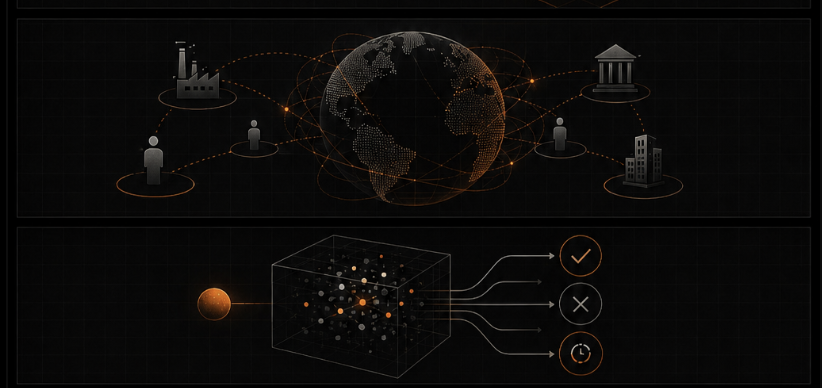
AI changed intelligence. We still only use it in the present.
Ask an LLM what happens if a company goes all-in on direct-to-consumer, and it will reason beautifully about retailers, acquisition costs, second-order effects. But it narrates the future in a single breath. It never lives it one step at a time.
We don't need a better storyteller. We need a synthetic world: a digital twin of the world.
Make the move inside one and watch what happens. Let retailers react. Let competitors respond. Let customers shift. Let media notice. Let investors reprice. Let employees change. Let the next six months happen, then another six, then a year. Then rewind. Change the move. Run it again. Ten thousand times.
Every action creates a reaction. Every reaction becomes the next reality.
The system has to be built the way the world is built: information is local, so there is always an information arbitrage. Incentives drive behavior; people respond to money, power, status, and fear, not to prompts. The world has memory; what happened two years ago shapes how today is read. And the future branches; there is no single correct next token for the world, only many possible next realities.
Judgment
Why does this matter? Because judgment is the bottleneck.
Judgment comes from experience, and experience comes from feedback. Chess players develop superb judgment because feedback is fast and free: ten thousand games by age fifteen. A leader gets a handful of big strategic bets in a career, each taking years to resolve, none of them repeatable.
Simulation is synthetic experience. It lets you survive the bad decisions without making them.
Run one world and you get a scenario. Run ten thousand and you get a map. Some futures collapse instantly. Some recur no matter what you change. Some hinge on an assumption you didn't know you were making.
Not certainty. Search.
Search the Future
We are starting with a Large Simulation Model: a system that instantiates a world, populates it with intelligent actors: humans and organisations, and lets it evolve. Large in actors, interactions, information, time, and branches.
A war game puts smart people in a room. But you can't fit a million people in the room, and you can't run the next three years ten thousand times before lunch. Computation removes that constraint. For the first time, foresight scales the way compute scales.
We are not predicting the future. Nobody can.
The future isn't a line waiting to be discovered. It gets created by millions of actors deciding under uncertainty. So the question isn't "tell me what will happen." It is: show me what could happen, and why. Show me which assumptions carry the weight, and which actors move the outcome. Show me the paths I'm blind to, and what changes if I act differently.
Every decision creates the reality. Today, you have to enter a reality to study it, an expensive way to learn. Chess was small enough for computers to make foresight computational. The real world was too big. Maybe it still is. But with agents, lower compute per intelligence costs, and the right simulation architecture, we can finally try.
To build a place where intelligence runs ahead of you, so that before you choose a reality, you can explore them.
Search the Future.
The Missing Piece
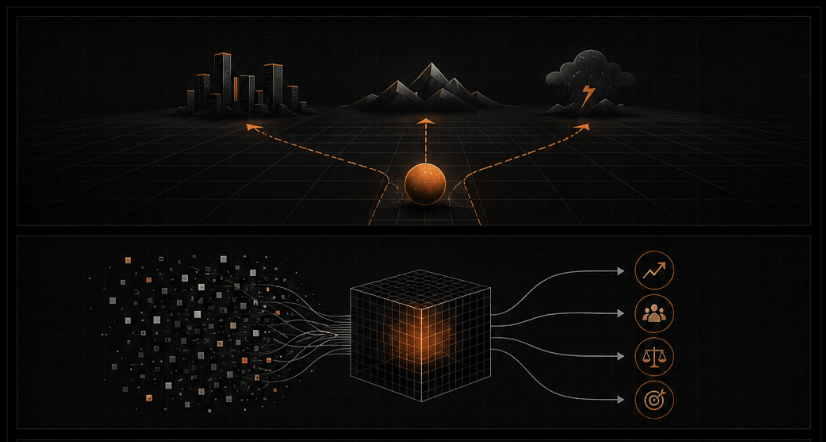
Simulation: The missing piece to get to Artificial Super Intelligence (ASI), Safely.
Imagine when we do get to ASI in the near future, what could we actually get it to do for us?
Pause and Think.
Even current AI models are mostly a black-box and when we do have something probably more intelligent than anyone else in the world, how do we know if its actions would actually lead to the desired outcome? AI Safety and p(doom) is a massive concern & for good reasons because we cannot reliably know what are the possible scenarios and which path it takes to reach that scenario.
The answer is 'Simulation'. We currently search the latent space for the next possible correct token but there cannot be a correct next token for the future.
Now, Imagine we do have a reliable system to simulate the society, we can guardrail the Super-Intelligence to 'simulate' a multiverse of possible futures that could entail. With Simulation, we as humans could see its possible Cascading Effects.
We are building towards this Abundant Future for Humanity.